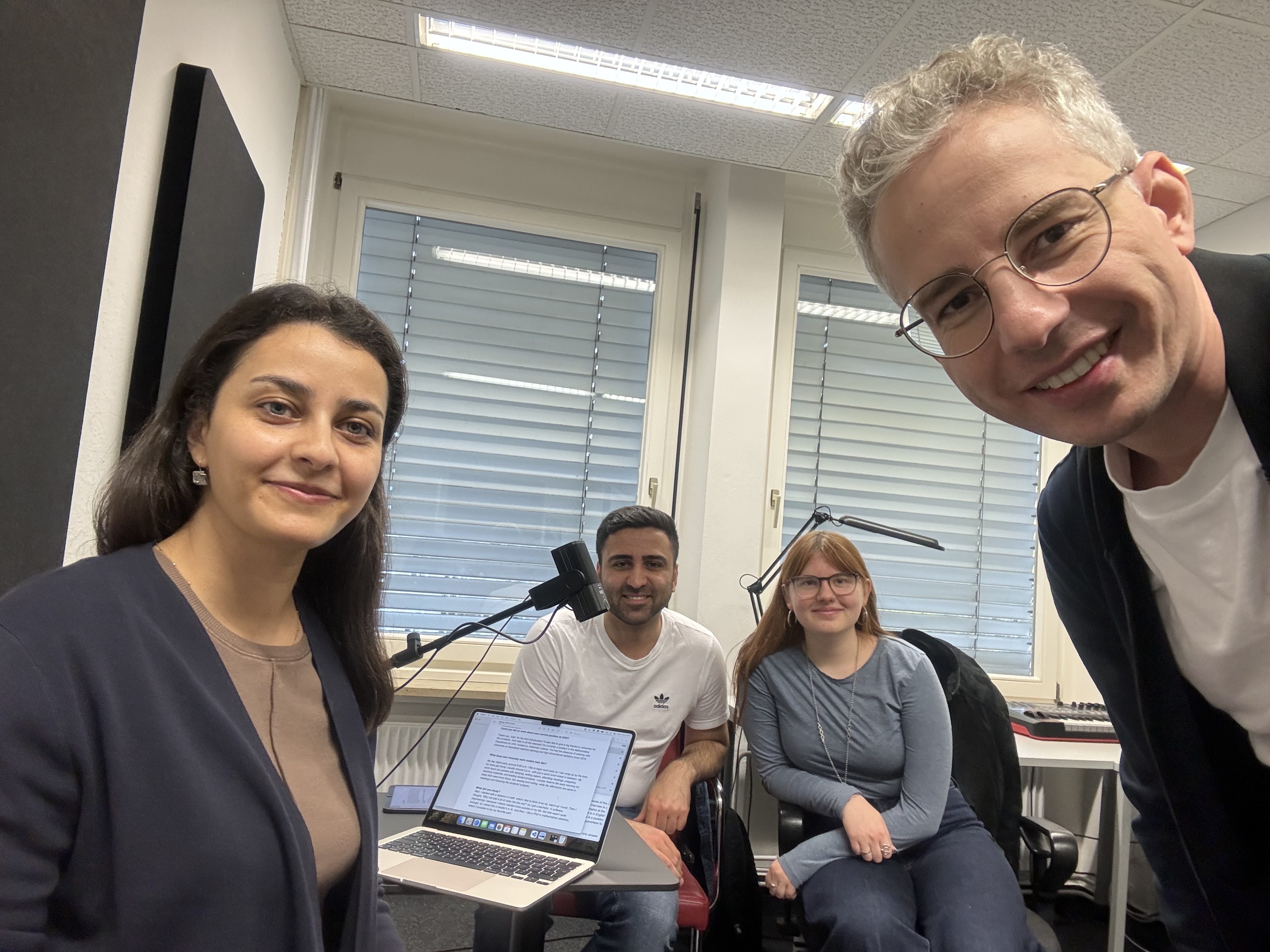
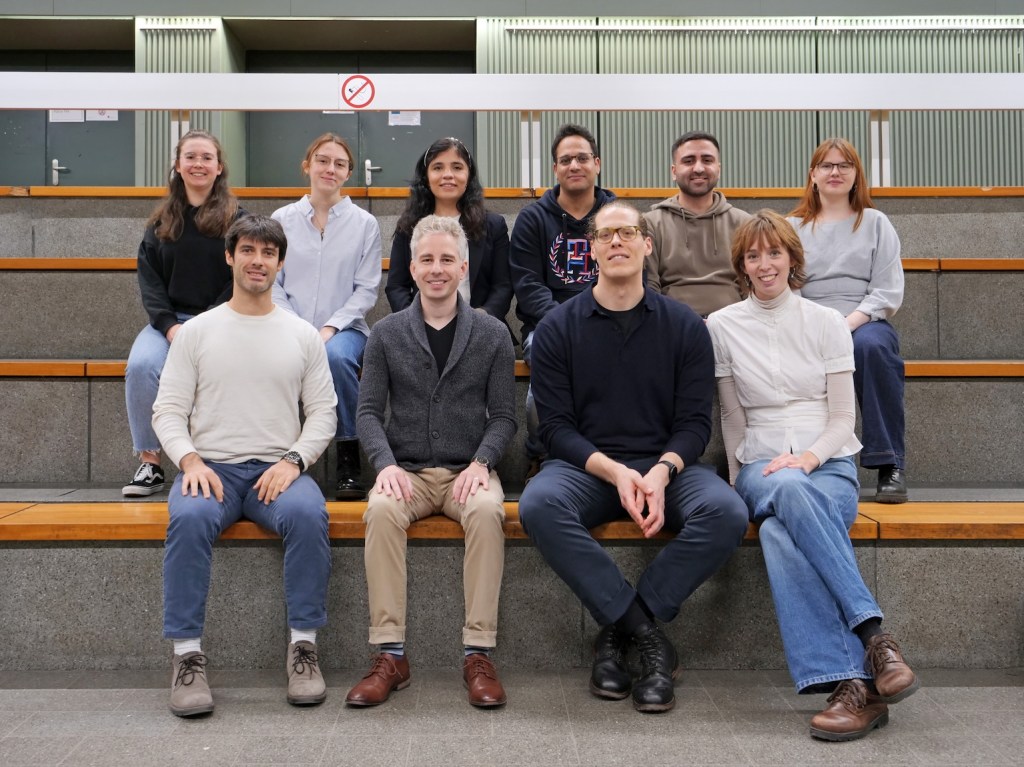
Anomaly detection attempts to identify “unusual” instances, that is, instances that deviate considerably from what is expected. Machine learning has become pretty good at detecting such anomalies—as long as abundant data are available. If data are scarce, however, the problem remains challenging. State-of-the-art approaches are multi-modal: they use several types of data simultaneously, usually images and text. But humans can often do well at anomaly detection using images alone. Our recent paper “AnomalyDINO: Boosting Patch-based Few-shot Anomaly Detection with DINOv2” has shown that the same is true also for machine learning. The reviewers agreed, and so our paper has been accepted for WACV 2025. 😁 Congrats to Simon and Mike, and thanks to our collaborator Asja! 🍷🍷🍷🍷
Folge 6: Kann ChatGPT mein Geld anlegen?
Mit Thomas Krabichler aus Luzern haben wir in unserer neuesten Podcast-Folge von “Data Science Talks” spannende Fragen aus der Finanzwelt besprochen. Wenn Ihr erfahren wollt, was KI auf den Finanzmärkten treibt, hört rein!
Congratulations Mike!
This week, Mike has successfully defended his PhD. Mike’s presentation was inspiring—just as his research leading to this PhD. Mike contributed to a variety of topics, ranging from high-dimensional statistics to generative models. However, Mike’s presentation showed that all these topics still fit a general notion of bias. You can find Mike’s papers in the publications tab on our homepage.
We were really fortunate to have Mike on our team for four years. It was also a great pleasure to co-advise Mike with Asja Fischer. Asja is an amazing researcher and mentor. I am sure we will have many more collaborations to come!
World Congress
Ali, Pegah, and Milena just returned from the World Congress in Probability and Statistics, where they showcased our work on mathematical machine learning and AI. They also brought a lot of inspiration and motivation back home to Hamburg.
Welcome back! We are proud that you are such great ambassadors for our team.
Hotel Bingo
Today, Johannes was interviewed for the German radio station NDR 2 about the probabilities to win their sweepstakes. It’s all mathematics! If you are interested in studying this field, consider joining UHH.
Podcast Updates
Unser Podcast wagt sich diesen Monat an grundsätzliche Fragen: Mit Eva Bittner habe ich diskutiert, ob und wie Menschen und künstliche Intelligenz zusammenarbeiten können. Hier gibts alle Infos über den Podcast. Reinhören lohnt sich!
Prediction With Clusters
Our paper “VC-PCR: a prediction method based on variable selection and clustering” has been accepted at Statistica Neerlandica. Congratulations to our wonderful team from Belgium: Bernadette, Rainer, and especially our student/postdoc collaborator Rebecca! 🇧🇪🇧🇪🇧🇪
Deep Learning in Geotechnics
We have a new paper titled “Deep learning-based analysis of true triaxial DEM simulations: Role of fabric and particle aspect ratio”, which will appear in Computers and Geotechnics. Thank you for Nazanin, Merita, Mohammad, and Torsten in Bochum and Pegah in Hamburg for this wonderful interdisciplinary collaboration! 🏗🏢🌎
Layer Sparsity
Our paper “Layer sparsity in neural networks” has now been accepted at J. Stat. Plan. Inference. Congrats to Mahsa, and many thanks to our great collaborator Mohamed! 🗼
Anomaly detection
Our new paper “AnomalyDINO: boosting patch-based few-shot anomaly detection with DINOv2” is now on arXiv. Thanks for the great efforts, Simon, Mike, and Asja! 👷♀️🏗👷♂️